
In old Basque belief the day belonged to Eguzki, the sun, and the night to Ilargi, the moon. When dusk fell, the roads and fields passed to the gaueko izakiak — the night beings: spirits, witches (sorginak), and the restless dead. People feared to leave their houses after dark.
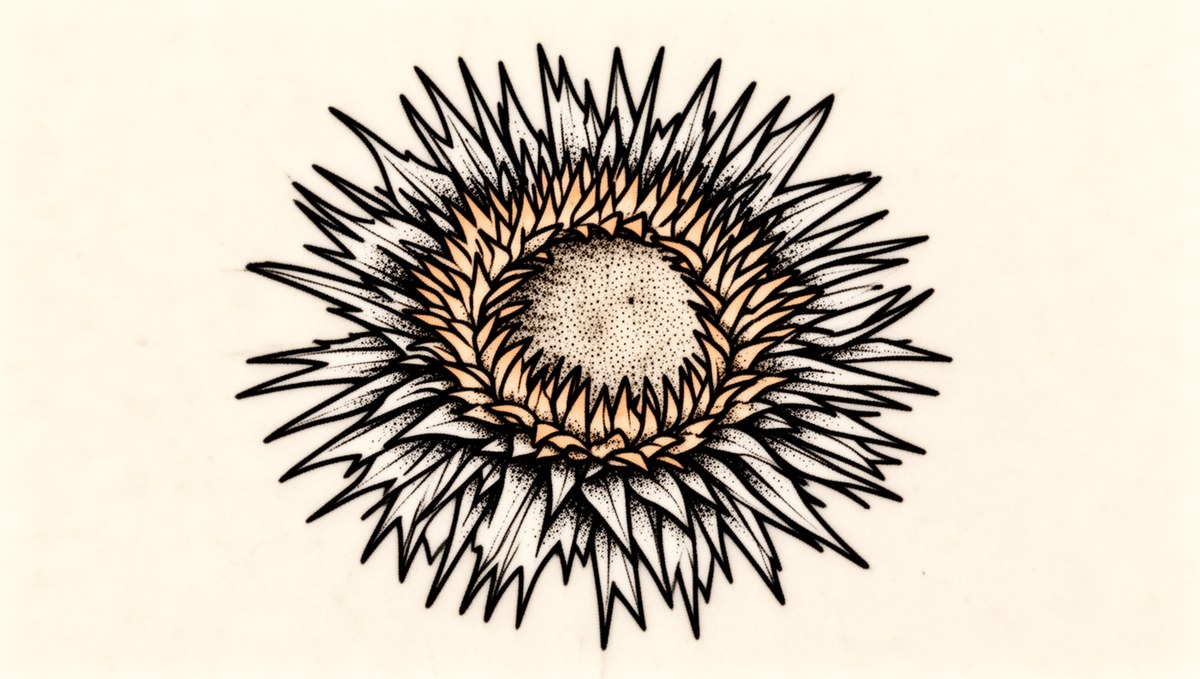
The legend says the people begged the sun to stay with them through the night. The sun could not — but she gave them a flower shaped like her own face, ray for ray, and told them to hang it over their doors. Seeing it, the night beings mistake it for the sun herself, and flee.
What hangs over the door
The dried head of Carlina acaulis was nailed above the lintel of the baserri (the traditional farmhouse), and also over barns, beehives and animal stalls. It was turned face outward, toward the road. Households credited it with keeping away:
- sorginak — witches, and ill-intentioned strangers;
- gauekoak — night spirits and shadows;
- begizko — the evil eye, especially upon children and cattle;
- ekaitza — storms, hail and lightning striking the roof.
The counting spirit
In some valleys the flower was said to work by a quieter magic: a spirit that wished to enter had first to count every seed of the head — and there are always too many. Dawn comes before the counting ends.
Names, solstice, and today
Besides eguzkilore you will hear ekilore and, in Spanish, carlina or cardo sol. The plant was gathered at the height of summer, around the solstice and the feast of San Juan, when its head is fullest — the same days when protective herbs were cut across the rest of Europe.
The custom is not museum material: dried eguzkilore heads still appear over doors in Gipuzkoa and Alava, and the flower turns up in Basque jewellery, pottery and graphic design as a quiet national symbol.
A spirit that wished to enter had first to count every seed — and there are always too many.
A modern reminder
In much of its range the plant is protected. The old custom of gathering it is best replaced today by photographing it — which is exactly what this site does.