
Carlina acaulis L., the stemless carline thistle, belongs to the family Asteraceae. Basque eguzkilore, Spanish carlina, English “silver thistle”: all names for one remarkable alpine perennial.
Description
- A stemless rosette of deeply cut, fiercely spiny leaves pressed to the ground.
- A single sessile flower head, 6–12 cm across, sitting at the centre of the rosette like a sun on a shield.
- The “rays” are not petals but silvery-straw coloured bracts; the true flowers are the dense golden tubular florets of the central disc.
- The bracts are hygroscopic: they spread open in dry sun and close tight over the disc in damp air — a folk barometer, and the reason dried heads “close” before rain.
Flowering and habitat
Flowering runs from July into September. The plant favours montane and subalpine grasslands, limestone pastures and sunny stony slopes, roughly between 600 and 2300 m. Its strongholds are the Pyrenees, the Cantabrian range and the Basque mountains — Aralar, Aizkorri, Gorbeia, Entzia — with wider populations across the Alps, Carpathians and Balkans.
Conservation
In parts of the Basque Country and Navarre the species is legally protected, and uprooting or picking it is prohibited. The folklore that made it famous also made it scarce near the roads. Please photograph, do not gather.
Cultivation notes
It can be grown in an alpine bed: full sun, gritty alkaline soil, perfect drainage. Winter wet, not winter cold, is what kills it. Sow fresh seed in spring; be patient — a rosette may take several seasons before it offers its one great head.
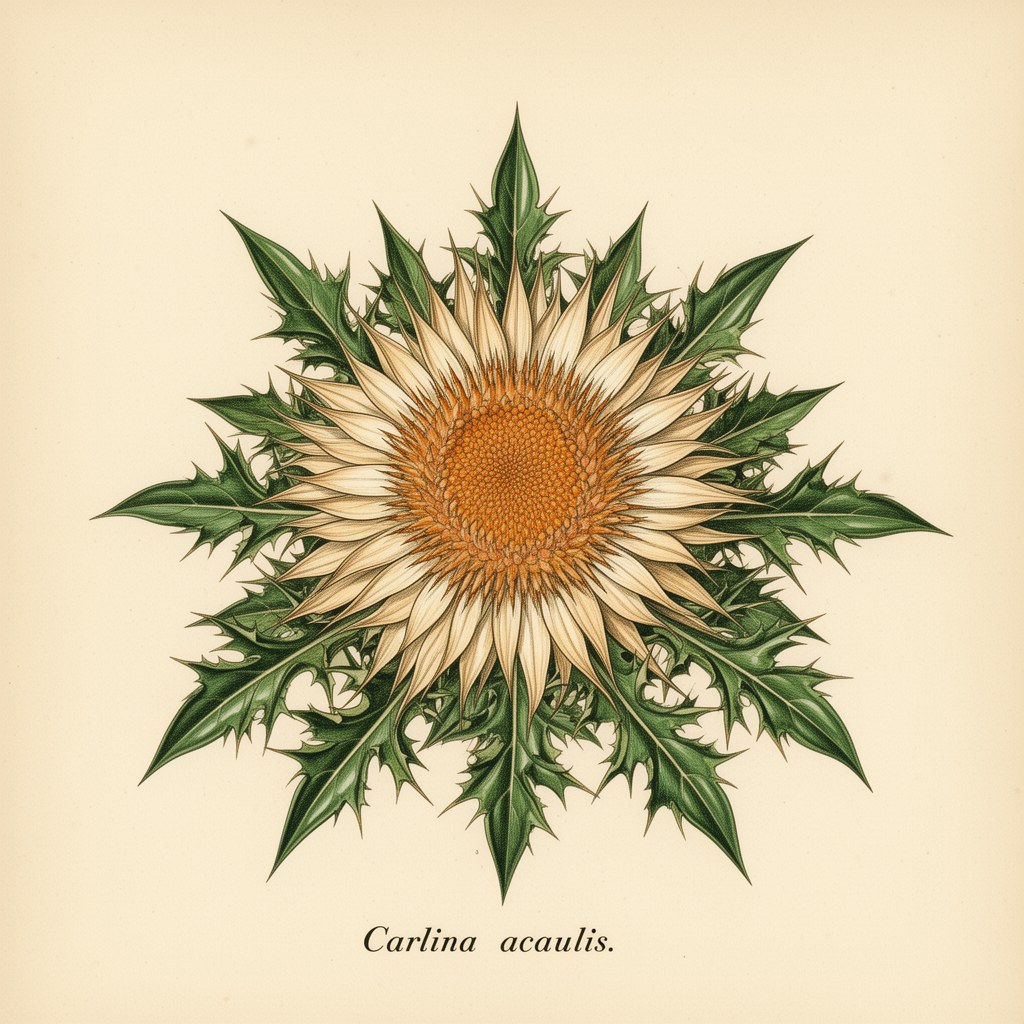
A folk barometer
Because the outer bracts open in dry sun and close in damp air, a dried head was read as a sign of weather — the same reason it “closes” over the disc before rain.